Breaking down relational barriers in access to cultural places
From physical barriers to relational ones: the role of communication and training for full and conscious cultural accessibility
by Franco Tartaglia
The issue of access to cultural sites by people with disabilities has been the subject of some important considerations in recent years. First of all, there is a general consensus, also at the legal/regulatory level, on the importance of including people with disabilities and their full participation in the various activities of society, including cultural ones. In particular, Article 30 of the UN Convention highlights how States must recognize the right of persons with disabilities to take part on an equal basis with others in cultural life and must adopt all appropriate measures to ensure access to places of cultural activities, such as theaters, museums, cinemas, libraries, monuments, and sites important for culture.
We are therefore talking about a right, not a favor or a courtesy, that of inclusion and accessibility, which materializes in the effort to remove barriers that prevent or make difficult access, enjoyment, and participation in various cultural activities. I also recall how disability is defined by the ICF 2001 as: «a health condition in an unfavorable environment», with a fundamental shift in perspective, from highlighting the limitation of the person with a disability to recognizing the role of the environment as a key element in determining the disability itself. If the environment is accessible, meaning free of barriers, the disability itself does not prevent the person from moving independently and participating in activities.
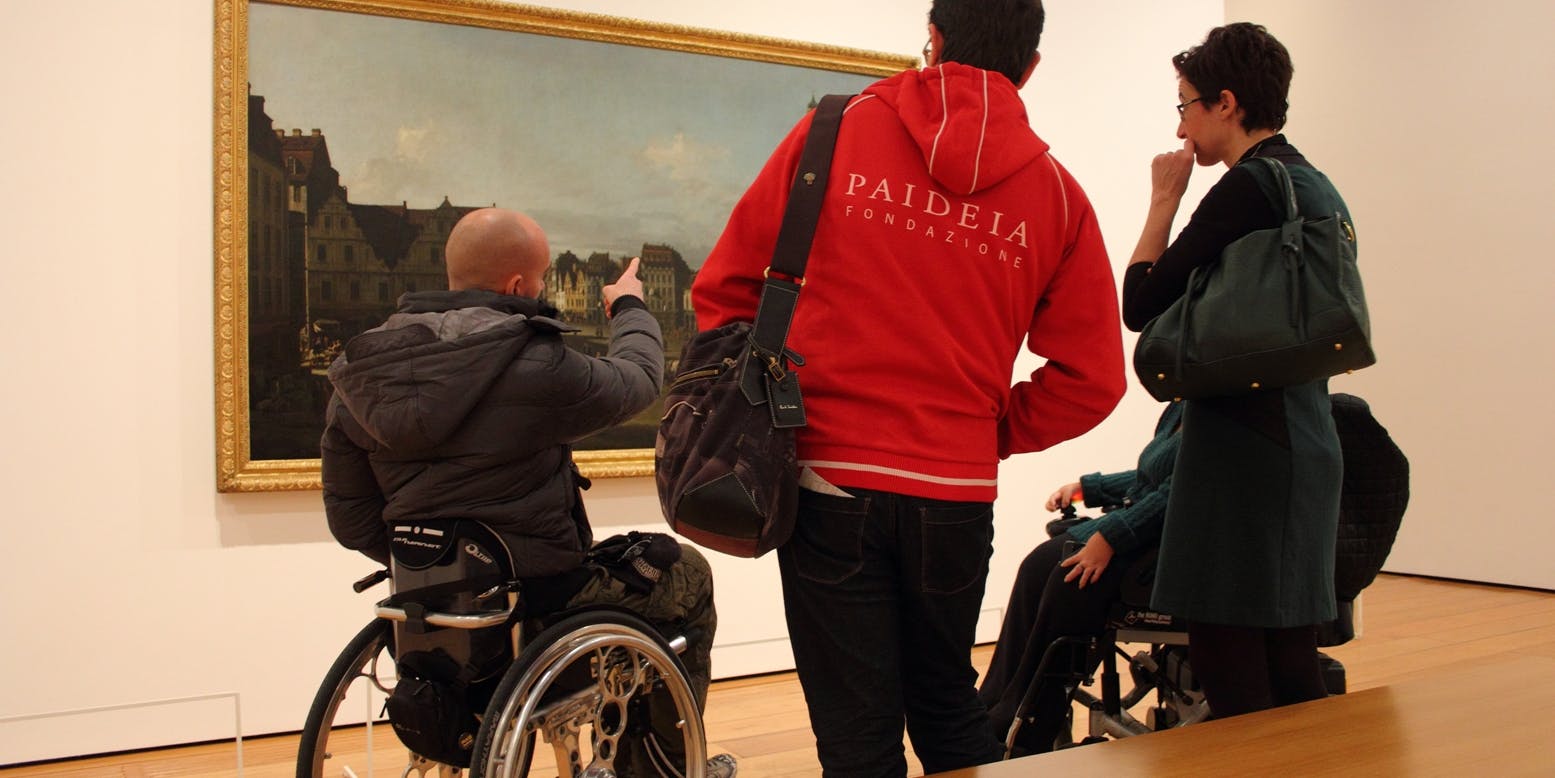
It is therefore clear the responsibility of cultural institutions to make themselves accessible by overcoming barriers, which can be of various kinds. Certainly, the most well-known and probably those on which the most work has been done are architectural barriers; these are structural, concrete barriers that effectively prevent or make difficult access and autonomous movement within the environment. The classic example is steps, carpets, narrow passages that prevent wheelchair access. It is evident that these barriers represent the first obstacle that a person with a disability may have to face when deciding to go to a museum or a theater. It must be said, however, that there is a good level of awareness and attention in the cultural field regarding these barriers. The ideal would be the logic of design for all, meaning buildings/environments designed from the planning stage with an inclusive perspective, usable by everyone, starting from the needs of the most fragile people. It is also evident, however, that many museums, for example, are located in historical buildings and inevitably require other solutions: the ramp next to the stairs, for example. The same design approach for all could also be applied to sensory barriers, making facilities accessible to blind or deaf people, or those with low vision or hearing, also providing artworks with highly readable fonts, or translations in LIS language and so on.
The issue of relational barriers is somewhat different; these are intangible, more difficult to recognize, more 'soft', and as such also more difficult to manage. They consist of all those barriers related to communication methods and the attitudes of cultural operators. For example, if a person with a disability at the ticket office meets an operator who rolls their eyes and has an irritated tone of voice, we are facing a relational barrier. We could find contexts perfectly accessible from a structural point of view, but not equally so from a relational one, because operators are not attentive, sensitive, and lack adequate communication skills to welcome, assist, and possibly support people with disabilities.
Let's look at the main relational barriers one might encounter:
- Absence, disinterest: this is the case of the operator who, faced with a person with a disability, turns away, moves away, avoids contact indifferently or irritably, giving a clear signal of annoyance which ends up being perceived as 'you would have been better off staying home';
- Lack of empathy: this is in the realm of communications lacking sensitivity, which show no attention to the interlocutor, discordant, like a case that was reported to me where in a museum an operator said to the mother of an agitated autistic child; 'madam, take him to a meadow so he can let off steam, the museum isn't good for him';
- Infantilization: the tendency to treat the person with a disability as a big baby, an eternal child, even when an adult. This barrier, for example, leads to not addressing the disabled person directly but asking questions to the companion ('does he want audioguides too?'), or addressing him but in a simplified way, as one would with a child;
- Pity: one of the heaviest barriers for people with disabilities, that of feeling pitied about their condition. It is the classic phrase that starts with 'poor thing…', or the many non-verbal communications that convey pity (rolling eyes, shaking heads, sorrowful looks…). These forms of communication devalue the person in front of you and make them feel inadequate, unfortunate, heavily emphasizing their condition;
- Welfarism: it is a kind of overzealousness, consisting of helping and/or intervening where it is not necessary because the person with a disability has all the skills and resources to manage on their own. It is often associated with pity: 'poor thing, leave it to me…', resulting in communicating inadequacy, incapacity, inferiority to the interlocutor.
These are barriers, as I said, completely intangible, very heavy for people with disabilities, or for families who sometimes choose not to go out or avoid certain experiences precisely to avoid facing this kind of obstacle. Moreover, these are not necessarily attitudes associated with malice; for example, pity and welfarism are often expressed by people willing to help, but in the wrong way, lacking competence. The key point is that these barriers can only be overcome through training work with operators, work that has a dual aim: on the one hand, increasing awareness of the errors present in these attitudes and their effects on people with disabilities; on the other hand, acquiring skills in interpersonal communication and relationship management.
The key point is communication, because communication is the tool through which the operator builds the relationship with the person with a disability and their companions. In particular, it is necessary to strengthen the communicative skills of personnel regarding the ability to transmit information, to listen, and to communicate with appropriate attitudes. These are skills that generally characterize interpersonal communication and communication with visitors, but in the case of the relationship with people with disabilities may require some specific attention.
Regarding the ability to transmit information, it is useful, where possible, to address the person with a disability directly, avoiding triangulations, and it is useful to do so trying to adapt one's language to the style and abilities of the person in front. This communicative flexibility is fundamental and is what allows oneself to be understood and to build a good relationship. It is not possible to communicate with everyone the same way, nor to resort to stereotyped recipes; a little attention to the other, a minimum analysis of their characteristics and expectations, and the construction of a message consistent with the situation being managed are required. Thus, for a person in a wheelchair with a motor disability, one can address them in a similar way to other interlocutors, but in the presence of a sensory or cognitive disability a simpler language, longer times, and more detailed explanations may be necessary.
In the case of listening, it is important to remember that the person with a disability is a full interlocutor, to be addressed with classic active listening techniques: asking questions, requesting feedback, rephrasing, and summarizing the conversation. In all phases of the relationship, from the simplest welcoming ones to the more complex ones of activity planning, it is important to involve and engage people with disabilities. A simple example: a museum intends to design a workshop for blind people, or a library wants to propose an activity aimed at people with autism? The best thing to do is not to try to imagine what their needs might be but to interact directly with the people, for example through associations, and listen to their needs and proposals to try in a negotiative and synergistic perspective to build truly for all.
Speaking of attitudes, that is, the way of relating to the interlocutor, operators must avoid all those ways that devalue people with disabilities and emphasize any limitations; however, all passive attitudes must also be avoided, those that do not take responsibility, that hide behind 'it’s not my responsibility'. A technically assertive attitude is optimal, an attitude of respect for people, mutual value, and searching for solutions beneficial to all parties.
These skills must be developed and constantly updated through training paths that involve cultural operators by both providing them with suggestions, guidelines, and advice on how best to communicate, but also actively offering moments of discussion, reflections on their experiences, discussion cases. A virtuous example is the project Cultural Operators for Inclusion, designed and managed together with Paideia Foundation and CRT Foundation, which for about 15 years has been addressed precisely to cultural operators, and also to top figures, of museums, libraries, theaters, offering opportunities for training, reflection, and discussion on these topics. The starting point of the project is precisely the consideration that the communicative and relational attentions I mentioned are in all respects skills and as such must be treated, offering operators occasions to train and develop these abilities. Only in this way can we reasonably guarantee that cultural places are truly accessible and that for people with disabilities, visiting a museum, or engaging in library activities, or a theater performance represent valuable and fully participatory experiences.