
Accessibility to cultural heritage and visual impairment
Accessibility for people with visual disabilities: tactile paths, inclusive tools, and participatory design
by Maria Camilla Capitani
Accessibility to cultural heritage is an ever-evolving process that fits into a broader landscape, involving different areas such as digital services, and finding its foundation in the principles of the Agenda 2030. In the cultural field, the beneficiaries of accessibility are potentially all visitors, each carrying specific needs.
Viewed from this perspective, accessibility is configured as a process of continuous innovation and adaptation, complex and challenging, which should be considered in every aspect concerning a place of culture. Among the many visitors with specific needs are people with disabilities, and in particular, people with visual disabilities, on whom this analysis will focus, with the aim of identifying elements useful to ensure a good level of hospitality and a meaningful and enriching cultural experience.
To ensure full enjoyment of the heritage, it is appropriate to offer the possibility of participating in dedicated visits, also inclusive and in mixed groups with people without disabilities, supported by specialized operators. At the same time, it is essential to guarantee the presence of permanent accessible paths or those designed for temporary exhibitions, which can also be explored independently.
For a person with visual disability, mobility can represent a significant limitation, especially in unfamiliar places lacking clear reference points. Consequently, the first element to consider is hospitality: it is essential that staff make themselves available to accompany the person -if alone-, according to their needs, offering their arm or walking alongside and signaling the presence of steps, uneven surfaces, or other obstacles.
Whether in the case of organized visits or autonomous use, staff must be aware that the guide dog can access all areas. Should a blind or visually impaired person request information, it must be provided clearly and promptly, avoiding vague indications such as ‘the room you are looking for is over there’ and instead favoring precise references, for example: ‘the room you are looking for is the first door on the right, at the end of the corridor’. Moreover, even without eye contact, it is essential to always address the person directly and not their possible companion. These are small attentions that demonstrate a real inclusive intention on the part of the cultural site.
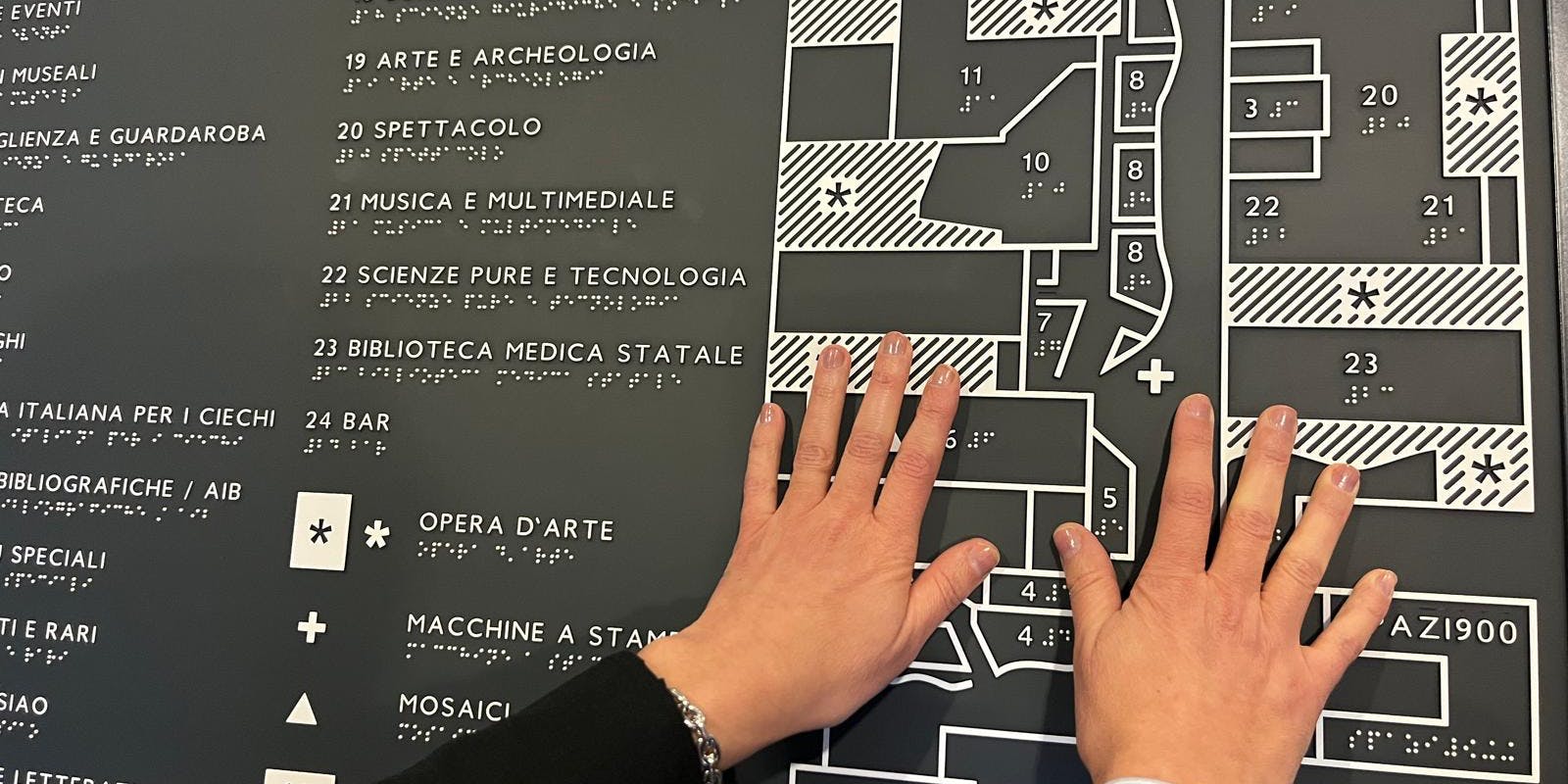
Once the path has begun, depending on the context, it is important that the works can be touched, as often happens in museums or archaeological parks, where statues and artifacts lend themselves to tactile exploration. Furthermore, appropriate aids must be present to facilitate orientation, such as tactile maps accompanied by a clear and easily interpretable legend. Such maps should be simple, not overly detailed, and positioned consistently with the direction of the path. Today, these tools represent a useful support not only for people with visual disabilities but for all visitors.
It is desirable that the tactile path includes, depending on the type of place, works preferably explorable without gloves, accompanied by braille captions and QR codes with audio descriptions. It is indeed important to consider that not all people with visual disabilities know braille, while the QR code is now a widely diffused and used tool.
To aid the understanding of spaces and architectural works, creating models, even dismantlable ones, allowing exploration of both the interior and exterior of the structures, proves very useful.
In the case of paintings, the presence of relief reproductions is essential, now achievable through various techniques. These reproductions should also include the use of color, an essential element to facilitate the understanding of people with low vision, who can complement tactile exploration with visual exploration. In this regard, it is important to remember that tactile reproductions must always be placed next to the original, adequately illuminated and positioned avoiding reflections.
The visual conditions of people with low vision, in fact, vary greatly from person to person: some retain better central vision, others more functional peripheral vision. Meeting all needs is complex, but reasonable accommodations can represent a valid starting point. Likewise, it is essential that written texts present high color contrast, avoiding light characters on light backgrounds or dark on dark backgrounds, favoring high-contrast combinations like black and white.
Another central aspect concerns language: descriptions must be clear, detailed, and comprehensive, also focusing on colors. While it is true that those who have never seen do not have a direct cognition of color, an accurate description still helps build a richer and more inclusive mental image of the work, especially considering that those who lost their sight during life or a person with low vision retains a visual memory of colors.
As emerges from what has been said, although blind and visually impaired people fall within the same category, conditions can be very different. Meeting everyone's needs is not easy, but sometimes targeted solutions are enough to improve the usability of works. For example, enlargements on A3 format can help a person with low vision better view a work, especially when the tactile reproduction does not restore color.
To achieve truly effective results, identifying the adequate supports and the most suitable solutions for a specific situation the direct involvement of people with disabilities in the design and evaluation phases of accessible paths is fundamental. They are indeed the only ones able to express real needs and test supports under development, verifying their effectiveness.
The active involvement of people with disabilities is a crucial step, effectively summed up in the motto of the European Disability Forum: Nothing about us, without us.